
- Consultations

As a federal employee, you are afforded various protections against unlawful and unfair treatment in your workplace.
However, not all agency officials follow these guidelines and regulations as strictly as they need to.
If you believe your federal agency has unfairly disciplined, demoted, or even wrongfully terminated you, there are legal options.
The U.S. Merit Systems Protection Board (MSPB) oversees issues related to the unfair treatment of federal employees across the country.
To learn what legal options may be available in your situation, contact an experienced MSPB lawyer by sending an online message or calling our firm at (833) 833-3529 today.
At the Federal Employment Law Firm of FEDLAW, we have years of experience helping federal employees successfully resolve complaints of removals, suspensions, demotions, and other adverse actions in the workplace.
While there is no legal requirement to retain an attorney to represent you, doing so can significantly improve outcomes.
Pursuing an appeal against your employer is a complicated process, and a mistake could jeopardize your entire case.
* Required Fields
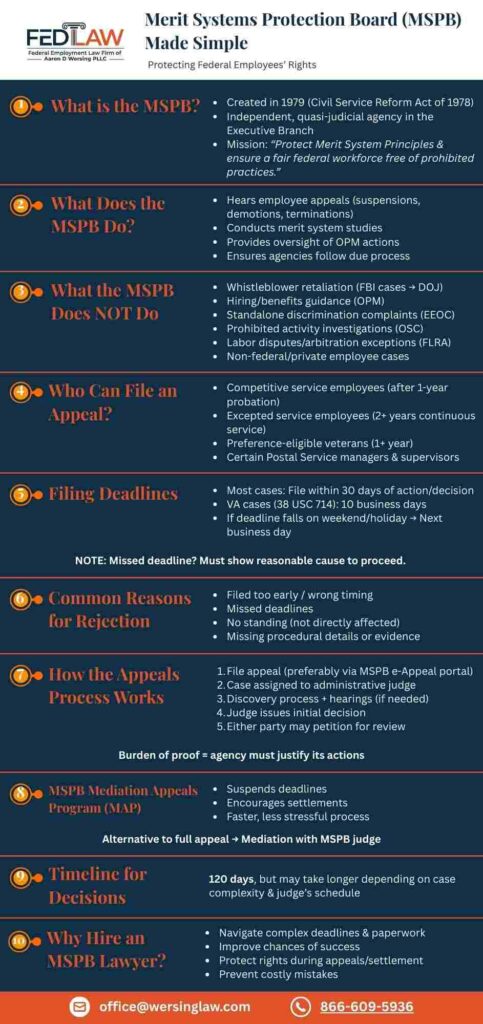
The U.S. Merit Systems Protection Board (MSPB) was created by the Civil Service Reform Act of 1978 (CSRA) and began operating in January 1979. It is part of the Executive Branch but functions as an independent, quasi-judicial agency with the primary responsibility of safeguarding the integrity of the federal civil service.
The MSPB was established alongside the Office of Personnel Management (OPM) and the Federal Labor Relations Authority (FLRA), replacing the former Civil Service Commission. Together, these three entities divided the Commission’s functions:
The MSPB’s statutory mission is to “Protect the Merit System Principles and promote an effective federal workforce free of Prohibited Personnel Practices (PPPs).”
The MSPB carries out its mission through several key responsibilities:
The MSPB provides oversight of certain OPM actions to ensure compliance with civil service law, including review of regulations and implementation of policies that affect federal employees.
Adjudicating Employee Appeals
Conducting Merit Systems Studies
The MSPB regularly conducts studies of federal personnel management practices to assess whether agencies are adhering to the merit system principles. Findings are reported to the President and Congress.
Oversight of OPM
The MSPB provides oversight of certain OPM actions to ensure compliance with civil service law, including review of regulations and implementation of policies that affect federal employees.
Examples of issues the MSPB does not deal with include:
The MSPB has no jurisdiction over non-federal appeals from private industry, city, county, local, or state employees.
Our MSPB lawyers have successfully handled numerous Merit Systems Protection Board cases.
Some of the most common issues appealed to the MSPB include:
As mentioned previously, the MSPB doesn’t handle all appeals. Some actions fall within the jurisdiction of other agencies and are not within the purview of the MSPB.
That is one reason why retaining an MSPB lawyer from the start is crucial. You could lose valuable time by filing a complaint with the wrong agency.
 Excellent ★★★★★ 4.8 | 100 reviews
 Due to continued mail delays, you should use the MSPB e-Appeal online portal to file and track your case.
Those federal employees eligible to file an appeal with the Board include:
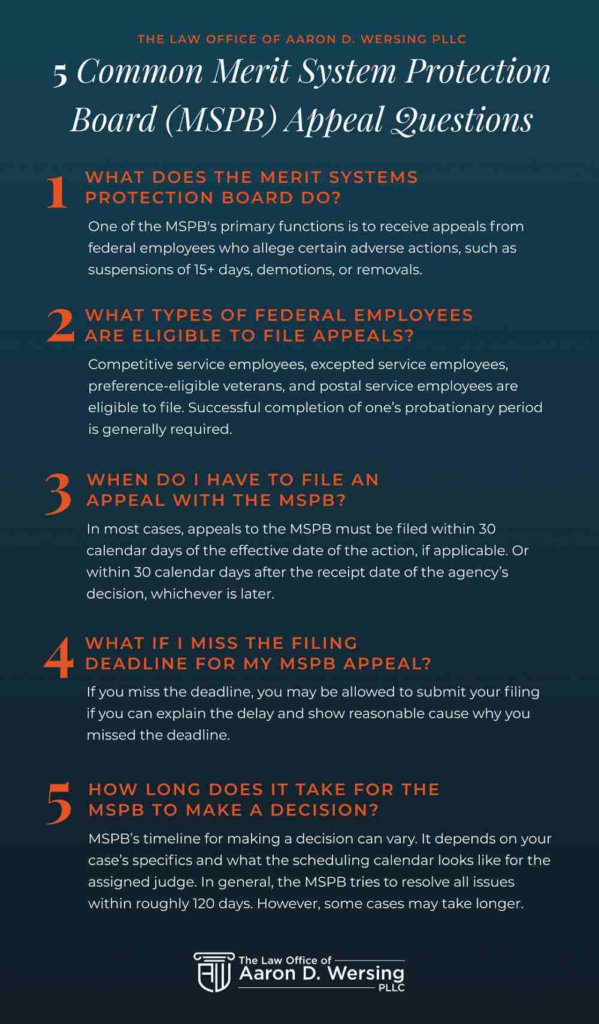
In most cases, appeals to the MSPB must be filed within 30 calendar days of the effective date of the action, if applicable, or within 30 calendar days after the receipt date of the agency’s decision, whichever is later.
There are exceptions to this timeline, such as actions taken by the Department of Veterans Affairs under the authority of 38 USC 714, which carry an appeal deadline of 10 business days from the effective date of the action.
In the event the last day falls on a federal holiday, Saturday, or Sunday, you will have until the next working day.
The timeline can vary further if your case falls under specific statutory requirements. If you file using the e-Appeal system, your date of filing is the date of electronic submission.
If you miss the deadline, you may be allowed to submit your filing if you can explain the delay and show reasonable cause for why you missed the deadline.
Do not skip filing because you think you need additional time to gather evidence.
You will still have time to get the necessary documents, and filing an initial appeal to meet the deadline can be done relatively quickly.
Once your case is assigned to a judge, they will order you to submit your proof at the required time. Adhering to stringent deadlines is essential.
That is one reason you should consider retaining a lawyer from an MSPB law firm to assist you with the appeals process.
Understandably, the stakes are high when you are at the stage of filing an appeal with the MSPB. Receiving notice that the MSPB has denied your appeal can be devastating.
In some situations, you may be able to file your appeal elsewhere or refile with the MSPB.
Some of the most common reasons the MSPB may reject your claim include:
To avoid unnecessary delays, make sure that you have all the required information when filing your claim. Your MSPB attorney can help you avoid common mistakes that can result in delays or denials.
Once your appeal is filed, the MSPB will assign an administrative law judge to your case.
The judge will issue an acknowledgment to you, your attorney, and your agency. The judge may also allow the parties to engage in the discovery process to obtain the necessary information for a hearing.
As your case progresses, the judge will issue additional notices and orders.
Depending on the circumstances of your case, the judge has the right to conduct one or more hearings to obtain clarity on the written information.
The judge may want to hear testimony from you, personnel from your agency, or other associated parties.
After the judge has reviewed all submitted information and listened to relevant testimony, they will issue their initial decision that addresses all legal and factual issues.
Depending on the decision, you or the agency can file a petition to have it reviewed. This filing is done with the Clerk of the Board in Washington, D.C.
It’s important to repeat that the burden of proof in MSPB appeals belongs to your employer, meaning that the federal agency must show the judge satisfactory evidence to support their charges against the employee.
You must show that the MSPB is the proper forum, that it has jurisdiction over your case, and that your appeal was filed within the deadline.
If your filing deals with whistleblower retaliation, discrimination harmful procedural errors, or other affirmative defenses, you must present proof of such claims.
One major advantage to pursuing a claim before the MSPB is their Mediation Appeals Program (MAP), which was launched as a pilot project in 2002, and expanded to all MSPB offices nationwide in 2005.
To elect this program, both the employee and agency, through its representative, complete and submit the proper forms.
Once those forms are submitted, all deadlines in the case stay, and the appeal is put on the mediation docket.
There are no deadlines to elect MAP mediation once an appeal is filed, and generally, such an election is supported by MSPB judges.
The MAP program provides many benefits, as an MSPB judge, although not the judge assigned to your appeal, will take on the role of mediator.
This judge can use his or her experience and knowledge to assist the parties in understanding the value of their case, and in coming to a resolution that both parties are able to accept.
As with any opportunity to negotiate a settlement of your case, it is very important to engage the assistance of an experienced federal employment attorney, since the signing of a settlement agreement marks the end of a case, and often bars additional claims based upon facts known to the employee at the time of settlement.
In other words, if you are given one chance to finalize a settlement, make sure you are getting the best deal you can.
Once the parties either settle or reach an impasse, the MAP judge will inform the appeal judge, who will either dismiss the case as settled or place it back on the docket for further processing.
MSPB’s timeline for making a decision can vary. It depends on your case’s specifics and what the scheduling calendar looks like for the assigned judge.
In general, the MSPB tries to resolve all issues within roughly 120 days. However, some cases may take longer.
You should expect that hiccups along the way will extend the amount of time it takes for the MSPB to issue its decision.
You may have one or more case suspensions under which deadlines are extended due to the judge’s calendar. The judge also needs ample time to draft a well-thought-out opinion for your case.
If you need assistance with filing an MSPB appeal, let our skilled legal team help.
Contact Federal Employment Law Firm of FEDLAW today, or give us a call at (866) 298-1244 today to schedule an initial consultation.
Let our federal employment lawyers put their experience and knowledge to work for you. We understand how much is at stake when you are filing an appeal.
Let us protect your rights and help you fight for the outcome you deserve.